
In my previous post, Rule Execution with SHACL, we have looked at how SHACL rules can be utilized to make inferences. In this post we consider a more complex situation where SHACL rules are used to classify baked goods as vegan friendly or gluten free based on their ingredients.
Why use SHACL and not RDF/RDFS/OWL?
In my discussion I will only concentrate on the definition of vegan friendly baked goods since the translation to gluten free baked goods is similar. Gluten free baked goods are included to give a more representative example.
Essentially what we need to do is look at a baked good and determine whether it includes non-vegan friendly ingredients. If it includes no non-vegan friendly ingredients, we want to assume that it is a vegan friendly baked good. This kind of reasoning uses what is called closed world reasoning, i.e. when a fact does not follow from the data, it is assumed to be false. SHACL uses closed world reasoning and hence the reason for why it is a good fit for this problem.
RDF/RDFS/OWL uses open world reasoning, which means when a fact does not follow from data or schema, it cannot derive that the fact is necessarily false. Rather, it is both possible (1) that the fact holds but it is not captured in data (or schema), or (2) the fact does not hold. For this reason RDF/RDFS/OWL will only infer that a fact holds (or does not hold) if it explicitly stated in the data or can be derived from a combination of data and schema information. Hence, for this reason RDF/RDFS/OWL are not a good fit for this problem.
Baked Goods Data
Below are example baked goods RDF data:

Bakery RDF data
A couple of points are important w.r.t. the RDF data:
- Note that we define both
VeganFriendlyandNonVeganFriendlyingredients to be able to identify ingredients completely. Importantly we state thatVeganFriendlyandNonVeganFriendlyare disjoint so that we cannot inadvertently state that an ingredient is bothVeganFriendlyandNonVeganFriendly. - We state that
AppleTartA–AppleTartDare of typeBakedGoodso that when we specify our rules, we can state that the rules are applicable only to instances of typeBakedGood. - We enforce the domain and range for
bakery:hasIngredientwhich results in whenever we saybakery:a bakery:hasIngredient bakery:b, the reasoner can infer thatbakery:ais of typebakery:BakedGoodandbakery:bis of typebakery:Ingredient.
Baked Good Rules
Now we define the shape of a baked good:

BakedGood shape
We state that bakery:BakedGood a rdfs:Class which is important to be able to apply rules to instances of bakery:BakedGood. We also state that bakery:BakedGood a sh:NodeShape which allows us to add shape and rule information to bakery:BakedGood. Note that our bakery:BakedGood shape state that a baked good has at least one property called bakery:hasIngredient with range bakery:Ingredient.
We now add a bakery:NonVeganFriendly shape

NonVeganFriendly shape
which we will use in the rule definition of bakery:BakedGood:
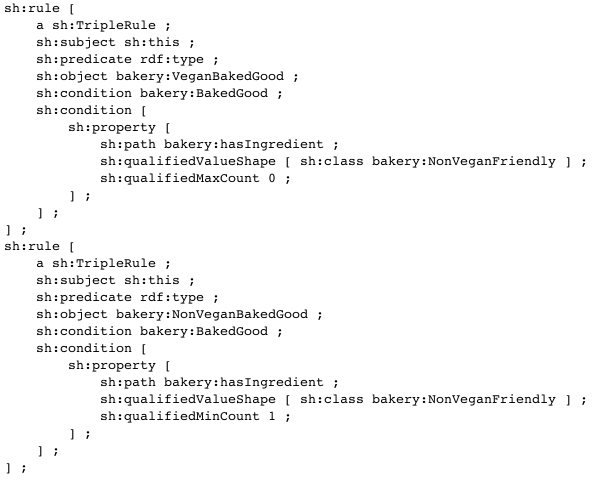
VeganBakedGood and NonVeganBakedGood rules
We add two rules, one for identifying a bakery:VeganBakedGood and one for a bakery:NonVeganBakedGood. Note that these rules are of type sh:TripleRule, which will infer the existence of a new triple if the rule is triggered. The first rule states that the subject of this triple is sh:this, which refers to instances of our bakery:BakedGood class. The predicate is rdf:type and the object is bakery:VeganBakedGood. So if this rule is triggered it will infer that an instance of bakery:BakedGood is also an instance of type bakery:VeganBakedGood.
Both rules have two conditions which instances must adhere to before these rules will trigger. These rules will only apply to instances of bakery:BakedGood according to the first condition. The second condition of the rule for bakery:VeganBakedGood checks for bakery:hasIngredient properties of the shape bakery:NonVeganFriendly. This ensures that the range of bakery:hasIngredient is of type bakery:NonVeganFriendly. If bakery:hasIngredient has a maximum count of 0, it will infer that this instance of bakery:BakedGood is of type bakery:VeganBakedGood. The rule for bakery:NonVeganBakedGood will also check for bakery:hasIngredient properties of the shape bakery:NonVeganFriendly, but with minimum count of 1 for which it will then infer that this instance is of type bakery:NonVeganBakedGood.
Jena SHACL Rule Execution Code
The Jena SHACL implementation provides command line scripts (/bin/shaclinfer.sh or /bin/shaclinfer.bat) which takes as arguments a data file and a shape file which can be used to do rule execution. However, for this specific example you have to write your own Java code. The reason being that the scripts creates a default model that has no reasoning support. In this section I provide the SHACL Jena code needed to do the classification of baked goods.

Shacl rule execution
Running the Code
Running the code will cause an inferences.ttl file to be written out to
$Project/src/main/resources/. It contains the following output:

Classification of baked goods
Conclusion
In this post I gave a brief overview of how SHACL can be used to do classification based on some property. This code example is available at shacl tutorial. This post was inspired by a question on Stack Overflow.
If you have any questions regarding SHACL or the semantic web, please leave a comment and I will try to help where I can.